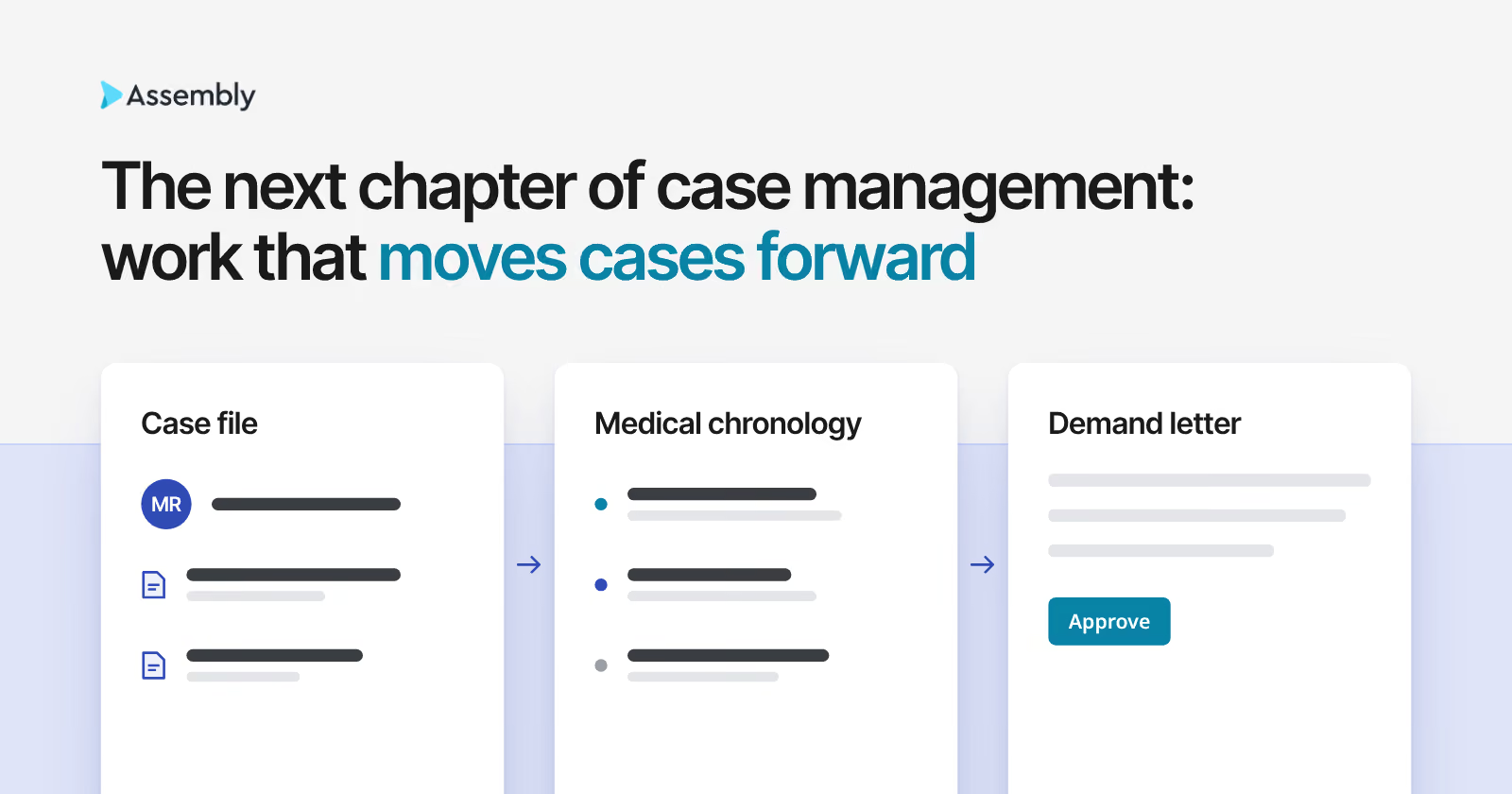
AI for personal injury lawyers pays off on a short list of high-volume tasks, especially reading medical records and drafting from them, and it stalls when it lives outside the case file or produces work nobody can check.
Key Takeaways
- The payoff is in the records. Medical record review, chronologies, and demand letters take hours on every personal injury case, and that is where AI saves the most.
- Most rollouts stall for workflow reasons, not model reasons. A second login, an export before every use, and output nobody can verify are the common reasons adoption can stall.
- Start with one task and measure it. Pick a task your team does on every case, put AI where that work already happens, and track hours before and after.
How Are Personal Injury Lawyers Using AI?
Personal injury lawyers use AI to read and organize medical records, build medical chronologies, draft demand letters, and answer questions about a case file. These are the tasks that repeat on every case and consume the most paralegal and case manager time.
Use is now routine. Law360 Pulse’s 2026 AI Survey found 70% of attorneys at law firms using AI at least once a week, up sharply from 2025. Most firms are no longer asking whether AI can draft. They are asking whether they can trust and check what it drafts, and whether it saves time on real case work.
Where Does AI for Personal Injury Lawyers Pay Off First?
Personal injury firms should start with the tasks that are high-volume, document-heavy, and easy to check against a source. Four fit that description:
- Medical record review and chronologies. AI reads the records, extracts dates of service, providers, diagnoses, treatment, and charges, and orders them into a cited timeline. Assembly estimates 4 to 8 hours to build one chronology by hand. See medical record review for law firms for how the options compare.
- Demand letters. AI drafts the treatment narrative, the specials table, and the standard sections from the records and the chronology. Assembly early estimates 3 to 10 hours to draft a demand letter by hand. See what goes in a personal injury demand letter.
- Questions about a case file. Asking where the client treated, when the last visit was, or which records are still outstanding, instead of opening every document.
- Intake and call notes. Summarizing intake calls and new-client paperwork into the case record.
What stays with your team on every one of these: causation, case value, strategy, and the final review before anything goes out.
Which AI Is Best for Personal Injury Law Firms?
The best personal injury AI is the one your team will use on every case and can check quickly. Options fall into three groups:
General-purpose AI chat
- Built for: Any writing task
- Getting the case to it: Paste or upload documents
- Where the output lands: In a chat window
- Can it cite the record? Rarely
- Logins for your team: One more
Standalone legal AI application
- Built for: One task, such as demands or chronologies
- Getting the case to it: Export and upload records per case
- Where the output lands: A document you download and file
- Can it cite the record? Depends on the product
- Logins for your team: One more
AI inside case management
- Built for: The work already in your case files
- Getting the case to it: Nothing to send; it works from the case
- Where the output lands: In the case file
- Can it cite the record? Depends on the system
- Logins for your team: None extra
Whichever group you look at, ask to see a claim in the output traced back to the exact page it came from.
Why Does AI Adoption Stall at Personal Injury Firms?
AI adoption stalls at personal injury firms because of where the AI sits in the workflow, not because the AI cannot do the work. Five patterns show up again and again:
- It lives somewhere else. If using AI means leaving the case file, logging in to another application, and coming back, people stop doing it within weeks.
- Every use starts with an export. When records have to be downloaded and uploaded before each draft, the prep eats the time the draft saved.
- Nobody can check the output. A draft without citations has to be re-verified by hand.
- It was piloted on the wrong task. A tool tried on occasional work never builds a habit. One tried on the chronology every case needs does.
- Nobody owns it. Without one person responsible for the workflow and the results, a pilot ends when the person who started it gets busy.
None of these is a model problem. Each one is a decision about where the AI runs and who is accountable for it.
How Do You Get AI Past the Pilot at a Personal Injury Firm?
Get AI past the pilot by tying it to one recurring task, running it where that work already happens, and measuring the hours. An example of a practical sequence:
- Pick one task your team does on every case, such as the medical chronology.
- Run it inside the case file, so there is no export and no second login.
- Name an owner, usually a senior paralegal or case manager, who sets the review standard for that task.
- Expand to the next task only once the first one is routine.
How do law firms measure legal AI ROI?
Measure hours on the specific task, not general satisfaction. Time 5 to 10 chronologies or demands by hand, then time the same work with AI including review. Multiply the difference by your monthly case volume.
How Does Neos Handle AI for Personal Injury Firms?
Neos puts AI inside the case file, so the records your team already collected are what the AI works from. Neos is case management built for personal injury firms, with 40 years of personal injury case management behind it. Demands Plus is part of Neos and handles medical chronologies and demand letters, the two highest-volume tasks on a personal injury case. It runs on NeosAI Platinum and works from the case your team already built.
- Medical chronologies. Every page of records becomes one timeline, with each entry cited to its page. Gaps in care of 45 days or more are marked, and possible missing records are listed for your team to check.
- Demand letters. Drafted from the chronology, following the structure of your firm's past demands, with every claim cited to the record.
- Review stays with your team. Demands Plus never estimates a case value, your team can edit any line, and an attorney approves the letter before it goes out.
Frequently Asked Questions
Will personal injury lawyers be replaced by AI?
No. AI can read records and draft from them, but causation, case value, negotiation, and trial judgment stay with lawyers. What changes is how much of a paralegal's or case manager's week goes to reading and re-typing records.
What is the best AI tool for personal injury lawyers?
The best AI tool for personal injury lawyers is one that works from the case file, cites every claim to the record, and leaves case value and final review with your team. For most firms, that means starting with medical chronologies and demand letters, the tasks every case needs.
Can AI help paralegals at a personal injury firm?
Yes. Paralegals and case managers carry most of the record review and drafting on a personal injury case, so they see the largest time savings. The work shifts from reading and typing to checking cited drafts: by Assembly's early estimates, a chronology that takes 4 to 8 hours by hand takes about 30 minutes with Demands Plus.
The Bottom Line
AI for personal injury law firms works when it sits where the case already lives and produces work your team can check.
- Start with medical records, chronologies, and demand letters, the tasks every case needs.
- Choose AI that cites the record and works inside the case file.
- Expect rollouts to stall on second logins, exports, and unverifiable output, and design around them.
- Measure hours on one task before expanding to the next.