Every personal injury case runs through the medical records. Someone has to read every page, put the care in order, and catch what is missing before anyone can value the case or draft a demand. Medical record review for law firms is that work, and most firms handle it one of three ways: an outside review service, a standalone AI application, or review built into case management.
This blog covers what a review produces, how the three approaches compare, and how to check the output.
Key Takeaways
- Medical record review turns records into a sourced timeline of care. The core output is a medical chronology, with every entry traceable to the page it came from.
- The slow part is reading, not writing. Assembly estimates 4 to 8 hours to build one medical chronology by hand, most of it spent sorting records that arrive out of order.
- Firms often choose among three approaches: outsourced services, standalone AI, or review built into case management.
- Your team decides what the flags mean. Software can mark a gap in care; only your team knows whether a record is missing.
What Is Medical Record Review for Law Firms?
Medical record review for law firms is the process of reading a client's medical records and bills, organizing the care into a dated timeline, and identifying the facts that matter to the claim: diagnoses, treatment, gaps in care, missing records, and charges. For a personal injury firm, it is the factual base for the demand letter, the case valuation, expert review, and deposition prep.
A complete review usually produces four things:
- A medical chronology: every visit, in date order, with its source.
- A summary of the treatment history in plain language.
- A list of gaps in care and records that appear to be missing.
- Medical charges tied to the visits they belong to.
What Is the Difference Between a Medical Chronology and a Medical Record Summary?
A medical chronology lists events in date order. A medical record summary tells the treatment story in narrative form. Medical summaries for law firms are usually built from the chronology, so most personal injury firms need the chronology first, before medical record summarization, the specials total, or the demand letter.
Medical chronology
- Format: Table or timeline, one row per visit.
- Ordered by: Date of service.
- Best for: Checking facts, finding gaps, totaling charges.
- Built from: The records directly.
Medical record summary
- Format: Narrative paragraphs.
- Ordered by: Course of treatment.
- Best for: Explaining the injury to an adjuster, expert, or client.
- Built from: Usually the chronology.
What Does a Medical Chronology Include?
A usable medical record chronology gives you seven fields for every entry:
- Date of service. The date the care happened, not the date the record was signed, received, or printed.
- Provider and facility. Who delivered the care and where.
- Reason for the visit. What the client presented with.
- Findings and diagnoses. Including diagnostic codes where the record has them.
- Treatment and procedures. Imaging, injections, therapy, surgery, and medications.
- Charges. What the visit cost, tied to the billing record.
- Source. The document and page the entry came from.
Why Does Medical Record Review Take So Long?
Medical record review takes long because the records are inconsistent, not just because there are many of them. Assembly estimates 4 to 8 hours to build a medical chronology by hand, and a heavy surgical file can take far longer. Five things slow it down:
- Records arrive out of order and in different shapes. One provider sends a clean electronic export, the next a faxed copy of handwritten notes, and a third sends bills months after the clinical record.
- The same event appears more than once. One emergency room visit can show up in the hospital record, the ambulance report, the imaging report, and the follow-up note.
- Bills and visits do not line up. Matching each charge to its visit is manual work, and it is where specials totals go wrong.
- Gaps need an explanation. A break in treatment of 4 months will be found by the adjuster, so your team needs to find it first.
- The file keeps moving. New records arrive after the chronology is built.
What Are the Three Ways Law Firms Get Medical Record Review Done?
Law firms typically send records to an outside review service, run them through a standalone AI application, or generate the review inside case management. These are the categories, not products.
Outsourced review service
- Who does the work: The vendor's staff, sometimes with nurse review.
- Getting records to it: Send records to the vendor.
- Turnaround: Days, longer on heavy files.
- When new records arrive: A new request.
- Where the output lands: A document emailed back.
- Feeds the demand letter: Only if someone carries it over.
Standalone AI application
- Who does the work: Your team, in a separate application.
- Getting records to it: Export and upload for each case.
- Turnaround: Minutes to hours.
- When new records arrive: Re-export and re-run.
- Where the output lands: A document you download and file.
- Feeds the demand letter: Only if someone carries it over.
Review inside case management
- Who does the work: Your team, in the system the case already lives in.
- Getting records to it: Nothing to send; the records are on the file.
- Turnaround: Minutes to hours.
- When new records arrive: New records are added to the same chronology.
- Where the output lands: In the case file.
- Feeds the demand letter: Yes, if the same system drafts the demand.
None of these is automatically right. Medical chronology services with legal nurse consultants fit a complex medical malpractice file, and a standalone application can be the fastest path for a firm whose case management has no AI. The cost that gets missed is the export, the upload, and the re-run every time records change.
How Does AI Handle Medical Record Review?
AI medical record review works by reading the records, pulling out the structured facts, and ordering them into a timeline your team then checks. Most systems that do this well follow six steps:
- Read the records. Optical character recognition turns scanned and faxed pages into text. Handwriting and poor scans are where errors concentrate.
- Classify each document. Office note, operative report, imaging study, bill, or lien letter.
- Extract the facts. Dates of service, providers, diagnoses, procedures, medications, and charges.
- Remove duplicates. One visit reported by three providers becomes one entry.
- Order the timeline and flag gaps. Breaks in care, escalation in treatment, and visits referenced in one record but missing from the file.
- Cite every entry. Each line links to the document and page it came from.
What can't AI do in a medical record review?
AI cannot decide causation, judge which entries matter most, or see records that never arrived. Those calls stay with your team, your attorneys, and your experts.
What Are the Best Practices for Reviewing Complex Medical Records for Legal Cases?
The best practice is to treat every chronology, from any source, as a draft until someone who knows the case has checked it against the records. Here's an example of a practical pass:
- Confirm the provider list against your records requests.
- Confirm the first and last dates of service.
- Walk every gap of 45 days or more and decide whether it is a real break in care or a missing record.
- Spot-check about 10 entries against their source pages.
- Check the dates. Records carry a date of service, a date signed, and a date received; the chronology should use the date of service.
- Reconcile the charges. Total the bills yourself and compare. If they disagree, the bills win.
What Should You Ask Medical Record Review Companies?
Ask any medical record review company or software vendor the same five questions:
- Can I click any entry and open the source page?
- Show me a review built from handwritten notes and a faxed record, not the demo file.
- What happens when new records arrive after the review is done?
- Where are my client's records stored, and who can see them?
- Does it feed the demand letter, or does someone re-key the timeline?
If the chronology and the demand come from separate processes, someone has to keep them matching each time new records arrive.
How Does Demands Plus Handle Medical Record Review?
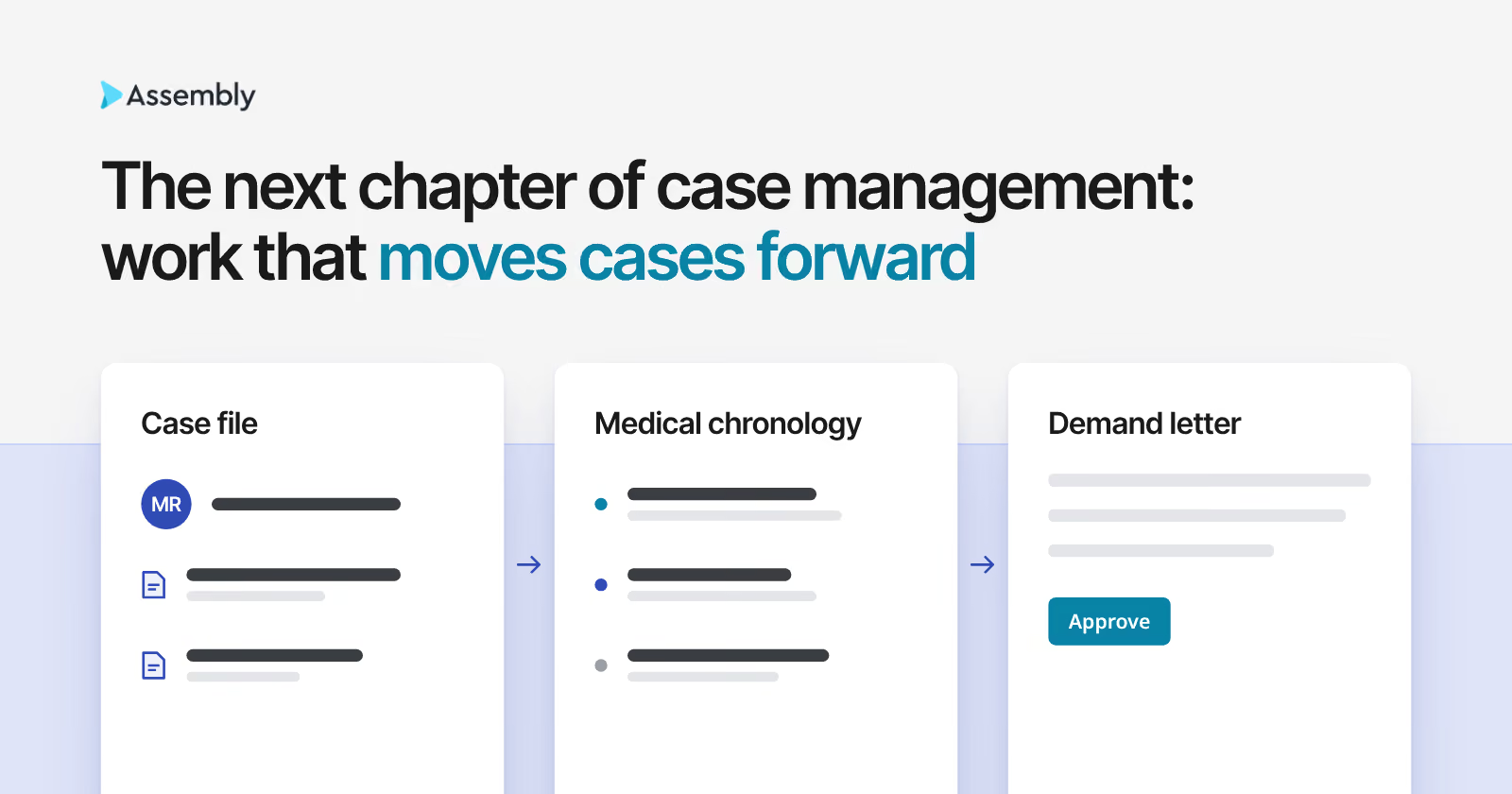
Demands Plus builds the medical chronology from the records already attached to the case in Neos, so there is nothing to export or upload. The same chronology feeds the demand letter Demands Plus drafts for attorney review. Demands Plus is part of Neos and runs on NeosAI Platinum. Neos is case management built for personal injury firms, with 40 years of personal injury case management behind it.
- One timeline of care.
- Flags for review.
- Current as records arrive.
- Exports that stay with the case.
- Records stay in Assembly's environment.
- The demand letter starts from it.
Assembly's working figure is 4 to 8 hours to build a medical chronology by hand and about 30 minutes with Demands Plus. That is an estimated 70 to 150 hours a month for a firm building 20 of them. Results vary by case and record set.
Frequently Asked Questions
How long does it take to build a medical chronology?
According to Assembly's estimates, a medical chronology takes 4 to 8 hours to build by hand, and longer on heavy surgical files. Demands Plus generates the draft from records already in the case in about 30 minutes. Results vary by case set.
Can AI review medical records for a personal injury case?
Yes. AI can read the records, extract dates, providers, diagnoses, treatment, and charges, and order them into a cited timeline. It cannot decide causation or tell whether a gap is real, so a person who knows the case still reviews the output.
Do law firms need a nurse to review medical records?
Not on every case. Many personal injury firms build chronologies in-house with paralegals and case managers, and bring in a legal nurse consultant for complex medical questions, such as a medical malpractice claim or a disputed surgical outcome.
The Bottom Line
A good medical record review gives you a chronology you can check against the source pages. Cutting the work from 4 to 8 hours to about 30 minutes matters only after that.
- Expect a sourced chronology, a treatment summary, a gap and missing-records list, and charges tied to visits.
- Choose among outsourced services, standalone AI, and review inside case management based on cost, speed, and where the records end up.
- Check every review against the records before it feeds a demand.
- Ask every vendor whether you can click an entry and see its source.
See how Demands Plus builds a medical chronology from the case file